



Launching a venture in your 60s is far from reckless; it’s often the best-positioned attempt you’ll ever make. The main hurdles that destroy early-career founders—lack of expertise
The Late-Career Advantage: Why Launching a Business at 60 Is Your Smartest Move Yet
That persistent business idea hasn’t faded. It’s been sitting quietly in the back of your mind for years—a specialized boutique, a niche consultancy, or a venture you promised yourself you’d start once the kids grew up and the mortgage was paid off.
Now, in your 60s, the moment has finally arrived. But right alongside the thrill comes a cold, late-night doubt: Isn’t this the age when people retire, not launch? Am I about to throw my hard-earned savings down the drain?
Search for “how to start a business at 60,” and you’ll find generic listicles meant for a 22-year-old or timid, hedging advice that misses the point entirely. No one is answering the two questions keeping you awake: Is this financial suicide, and how do I execute this safely?
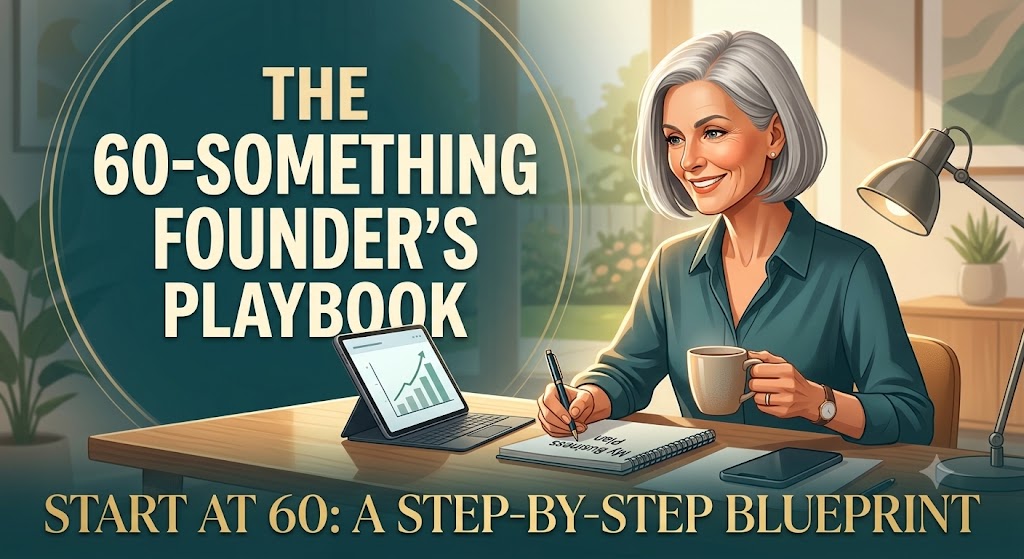
Why Conventional Advice Fails Mature Entrepreneurs
The modern startup landscape glorifies youth, celebrating founders who can risk it all, sleep on office couches, and spend years failing fast because they have forty years to recover. You don’t have that timeline, nor do you need that playbook.
Most advice ignores the fact that you already know how to operate. You’ve spent decades managing budgets, leading teams, navigating crises, and maintaining vendor relationships. You don’t need a motivational cheerleading squad—you need a pragmatic blueprint for financial self-defense, a method to test your concept, and recognition that experience is your single greatest competitive advantage.
The popular belief that 60 is for stepping back is not only loud—it’s factually wrong.
The Facts: Experience Is Your Greatest Asset
Launching a venture in your 60s is far from reckless; it’s often the best-positioned attempt you’ll ever make. The main hurdles that destroy early-career founders—lack of expertise, weak networks, and zero capital—are precisely the resources you’ve accumulated over four decades.
The data backs this up:
-
Age is an Asset: Economists studying 2.7 million U.S. company founders found that the average age of the top 0.1% fastest-growing startups was 45. Furthermore, a 50-year-old founder is 1.8 times more likely to achieve top-tier growth than a 30-year-old. Success rates continue climbing well into the late 50s.
-
A Common Path: Self-employment is widely embraced in later career stages. Among working Americans aged 65 and older, 23% are self-employed—more than double the rate (10%) for workers aged 25 to 64.
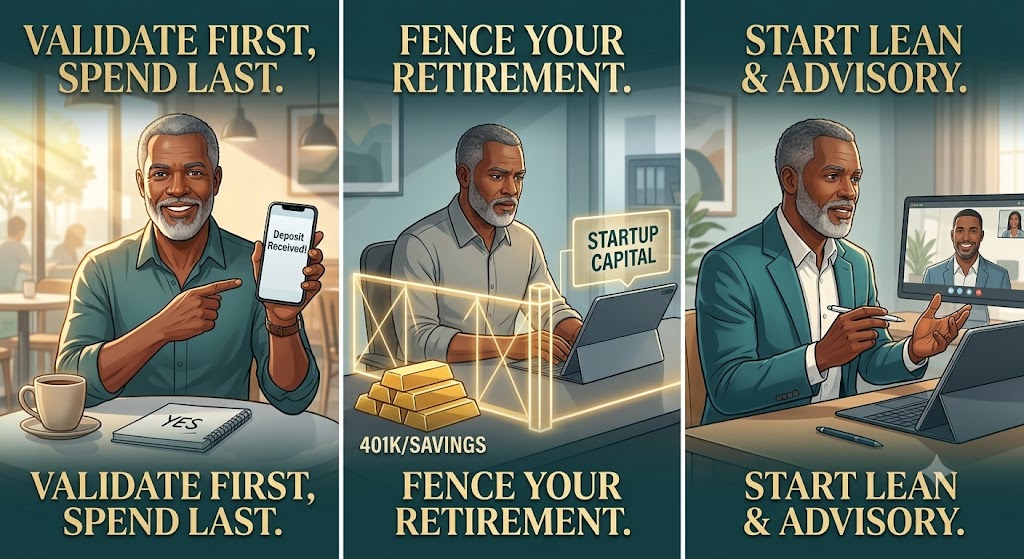
The 6-Step Strategy for Low-Risk, High-Reward Execution
Sequence is everything. By following these steps in order, you capture maximum upside while insulating yourself against major financial hits.
1. Find Your Intersection
Avoid chasing trendy business ideas. Focus instead on the sweet spot where three key elements overlap:
-
What you know inside and out.
-
What energizes you.
-
What customers will actually pay for.
Missing any one of these leads straight to creating a job you’ll eventually resent.
2. Secure a Paying Customer First
Before registering an entity, building a website, or ordering inventory, secure your first paying client. A signed contract or deposit proves market demand faster than six months of business planning. If your experience and network can’t secure one paying client, throwing money at the business won’t fix the core issue.
3. Build a Firewall Around Your Retirement
Establish a non-negotiable budget for your venture. Decide the exact amount you are comfortable spending, treat it as your absolute limit, and never touch your core retirement nest egg. Your retirement savings guarantee your long-term security; they are not venture capital. If the business cannot survive without tapping into your core savings, it is telling you it isn’t viable.
4. Keep Overhead Minimal
Starting smart means keeping fixed costs near zero. The median cost to start a business in the U.S. is roughly $25,000, and 53% are operated directly from home. Avoid long-term leases or heavy overhead until steady revenue pays for those expansions.
5. Establish a Basic Legal & Financial Structure
Protect your personal assets right away:
-
Form a simple entity (like an LLC).
-
Open a dedicated business bank account.
-
Consult an accountant early on.
This keeps your personal savings legally separate from your commercial liabilities—offering essential protection.
6. Play the Long Game
Business growth takes time. Approximately 50% of U.S. employer businesses reach the five-year mark, and one-third survive to ten years. Establish clear key performance indicators (KPIs) early on to measure true progress, and leverage the patience that comes with maturity.
Real-World Examples
-
The Practitioner: Mark, a executive chef at 61, wanted to launch a catering company. Instead of buying a commercial fleet or leasing space, he rented kitchen time at a local incubator for two pre-paid events. His startup outlay remained under $3,000, leaving his retirement completely untouched while yielding a profitable, satisfying venture.
-
The Consultant: Dave leveraged 28 years of supply chain expertise into fractional logistics advising. By securing two retainer clients over informal meetings before spending a dime on branding, he monetized decades of judgment with zero capital risk.
Purpose as a Driver
Building something meaningful isn’t just financially rewarding—it’s healthy. A long-term study of nearly 7,000 adults over age 50 showed that individuals with a strong sense of purpose had significantly higher survival rates than those without. A business tailored to your pace offers structure, engagement, and autonomy without requiring 80-hour workweeks.
Your Action Item for This Week
Before buying domain names or printing business cards, grab a single sheet of paper and define:
-
Your Core Capability: What skill do you master effortlessly?
-
Your Target Market: Who has an immediate problem that this skill solves?
-
Your Hard Capital Limit: What is the maximum amount you are willing to invest? Draw a circle around this number.
Everything inside that circle is your working capital; everything outside remains your protected future. You aren’t taking a wild gamble—you are executing a well-calculated, highly informed venture.
Quick Reference & FAQ
-
Am I too old to launch at 60?
No. Data confirms that mature founders exhibit higher success rates, backed by stronger networks, proven judgment, and deep practical experience.
-
How much capital do I really need?
Many service-based or consulting businesses can be launched for under a few thousand dollars by working remotely and keeping initial overhead low.
-
How do I safeguard my retirement?
Set a strict budget limit, operate via a separate legal entity (like an LLC), and never pull funds from your core retirement portfolio to cover operational expenses.
-
What are the best business models for this stage?
Low-overhead, high-expertise ventures such as advising, specialized services, instruction, and project-based consulting offer the fastest path to profitability with minimal capital risk.